14.02.2025

Banking Trend Monitor 2025: AI-based technologies on everyone's lips alongside open banking

Banking trend monitor 2025

In 2025, banks and financial service providers will undoubtedly face significant challenges: Their services and products are increasingly under scrutiny due to new regulatory requirements, such as the DORA regulation coming into effect in January. At the same time, banks must pursue a strong customer-centric approach to survive in the market. Rapid developments in AI technology provide an unprecedented technological push that forces all players—regardless of size—to keep up or risk falling behind. Other new or established trends, such as Open Banking, are also driving the continuous shift towards greater customer centricity in the banking sector.

In this dynamic environment, it is crucial to stay up-to-date to maintain a connection with customers and the market. Therefore, this blog post aims to provide an in-depth look at current trends in the banking sector and their place in the classic hype cycle.

Many developments mentioned in our previous trend monitor have evolved since 2023, and we will thoroughly evaluate the corresponding changes. Furthermore, we will introduce new trends that are emerging in the industry and could significantly influence the strategies of banks and financial institutions. We draw on our own expertise as well as insights from leading market experts (as presented in our article about the Handelsblatt BankenTech Messe 2024). Other technologies mentioned in 2023 have become established and are thus not included in this edition.

The objective of this article is to provide banks and financial service providers with valuable insights into how they can prepare for the challenges and opportunities of the coming years.
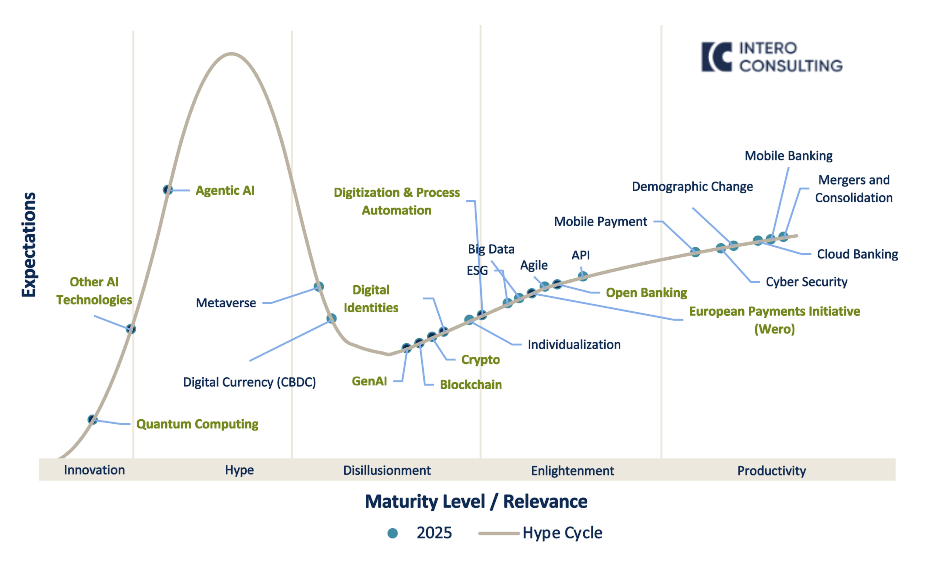
Evolution of Individual Trends Compared to 2023 Versatile AI Technologies Establish Themselves as True Game Changers in the Fight for Customers

The umbrella term Artificial Intelligence was already mentioned in our 2023 Trend Monitor. Given the immensely strong development in recent years, it only makes sense to differentiate further "AI", as many different use cases and subfields have evolved at varying rates.

Generative Artificial Intelligence (GenAI) undoubtedly experienced the biggest upswing. We already described this movement in an earlier contribution. Through the integration of Large Language Models (LLMs), countless new possibilities are opening up for banks and their customers regarding customer interactions and processing customer inquiries. An example of this is the DZ BANK chatbot, which can automatically offer customers tailored solutions to their problems. Many other banks either already offer similar solutions in their companies or are about to do so. The use of these LLMs thus also contributes to the ever-present meta-trend of individualization and customer-centricity. Due to the market-wide presence of GenAI, we no longer classify this trend as mere hype: users correctly understand the potential and also know the (current) limitations of GenAI, so we place this technology in our hype cycle just before general introduction.

Another application of AI is still in its infancy and could massively change not only the banking sector but also other industries shortly. Agentic AI refers to a concept within artificial intelligence where systems can act independently and achieve goals without the need for human-written prompts. These systems use complex thinking and planning processes to autonomously solve often multi-stage problems. Agentic AI stands out for its ability to self-direct and adapt to different situations, making it a promising tool for various applications. For example, these "agentic systems" can be used to detect fraud and money laundering cases by monitoring suspicious transaction patterns and anomalies. Agentic AI is also used in other areas, and banks and financial companies are facing a revolution in the banking sector with this technology.

In addition to Agentic AI and GenAI, other technologies based on Artificial Intelligence are currently emerging. For simplification, we summarize these here as Other AI Technologies. These technologies are still in development, but their potential is foreseeable. These include, without claiming to be exhaustive, technologies such as AI Simulations, Decision Intelligence, and more. We refer here to the Gartner AI Hype Cycle, which was published in November 2024.

It is clear: Artificial Intelligence is being applied in very different areas in the financial industry. This current hype continues, and the range of use cases will continue to grow, which is why we position this trend on our hype cycle near the peak of hype.

  • Cooperation between FinTech Companies and Banks creates new customer-centric business models, but also entails regulatory requirements

    Another existing trend is not primarily a technology in the traditional sense, but rather a movement. Open banking (referred to as the "platform economy" in our previous Trend Monitor) is no longer just an option, but a necessity for many banks and other companies in order to remain competitive. FinTech companies are cooperating with banks and jointly creating business models that ensure a smoother customer experience in the long term. At the same time, these developments are causing major change in the financial sector, which is putting banks under great pressure to act. The FIDA regulation, which is due to be adopted soon, formalizes existing processes in open banking and also creates a framework for new developments for FinTechs, banks and, of course, end consumers. In a previous article, we published a summary of the content of the FIDA RegulationDigitalization & Process Automation Must Remain a Focus to Continue Working Off Digital Backlogs and the resulting regulatory requirements.

  • Digitalization & Process Automation must remain a focus to continue working off digital backlogs

    Although not based solely on AI, the topic of digitalization and process optimization is still a major trend. In our previous Trend Monitor, we summarized this area as "RPA" (Robotic Process Automation). With our new, broader description, we are including a larger topic area. Streamlining existing processes is an ongoing topic in all industries. Current use cases in banking for the necessity of automated and lean processes include the processing of instant payments or the fulfillment of the requirements of the FIDA regulatory template.

    German financial service providers are still lagging behind internationally when it comes to digitalization. According to executives in the German banking sector, a lack of budget, skills and data gaps exacerbate these effects all the more. Against this backdrop, it is all the more important for the financial sector to keep pace by streamlining existing processes and implementing other digitalization projects. Current paradigm shifts in the area of no-code and low-code should reinforce this effect all the more and ensure that the trend of digitalization & process optimization is also on the cusp of "introduction" in our hype cycle. Last year, Intero Consulting bundled its initiatives and established a dedicated digitalization competence unit to advise our clients on the digitalization roadmap.

  • Increasing acceptance of cryptocurrencies and blockchain opens up completely new opportunities for financial service providers

    Other trends and ideas mentioned in our current Banking Trend Monitor have also been anchored in the financial sector as a fashionable movement for several years. Cryptocurrencies and blockchain can be taken as an example of this. We already identified the trend technology behind Bitcoin and co. as such in our previous Trend Monitor. Despite the global focus on AI and the associated temporary disillusionment triggered by market fluctuations and regulatory uncertainties, crypto remains a key topic in the financial sector. In particular, the increasing acceptance of cryptocurrencies by institutional investors and the further development of blockchain applications for financial transactions offer new opportunities for financial service providers. Commerzbank, for example, entered into a partnership with Deutsche Börse subsidiary Crypto Finance last September.

    Not least due to the US presidential election last November, an upward trend can be observed around crypto, which continues to generate euphoria among investors. Crypto ETNs (exchange-traded notes) should be highlighted at this point, as they offer a more stable alternative for investors, similar to traditional ETFs.

    The importance of crypto assets is also increasing in Europe. The MiCAR Regulation, among other things, is intended to ensure uniform regulation of crypto-assets throughout Europe. There are already

    The technology is also showing its benefits outside the stock market in other areas: Blockchain or other decentralized solutions can be used to

  • European payment providers and digital currencies are shaking up the European market

    Last year, the European Payments Initiative cited the Wero platform as a European alternative to American instant payment providers. Retailers see great potential in Wero, not least to become less dependent on PayPal, Visa and Mastercard. The platform can currently only be used in Germany, Belgium and France, but a gradual expansion across Europe is planned.
    There is also movement from the central banks in the area of digital payments.

    The ECB is currently examining its options for introducing a digital euro in order to increase the efficiency of payment transactions and modernize monetary policy. No concrete direction is yet known - but although the technical and regulatory challenges are great, CBDCs offer the long-term potential to revolutionize international payments and redefine the market position of banks.

New trends in the Banking Cycle 2025

Compared to our Trend Monitor from 2023, some trends appear for the first time in this edition.


Digital Identities Enable More Efficient and Secure Identification and Verification of Customers

The trend of Digital Identities in banking is also gaining increasing importance as banks and financial institutions must adapt to the requirements of digitalization. The reusability of KYC (Know Your Customer) is seen as a central aspect that can fundamentally change the customer relationship. Digital identities offer the possibility to identify and verify customers more efficiently and securely, thereby better meeting compliance requirements. Moreover, increasing digitalization opens up new approaches for Open Banking by promoting seamless integration and interoperability between different service providers.

A driver for this topic in 2025 will be the eIDAS regulation, which has been in effect since 2016 and was recently revised. The amendment is intended to enable EU citizens to securely identify themselves online and use electronic signatures in a unified system, as well as strengthen trust in digital transactions. All EU member states must offer a so-called "Identity Wallet" for their citizens by 2027.


Quantum Computing Is Considered a Future Technology, but Could Rapidly Gain Momentum in the Coming Years

A technology that is still in the experimental phase could have a major impact on finance in the future. The idea of quantum computing has existed since the 1980s; the first quantum computer has officially existed since 1998. Rapid developments between 2023 and 2024 show a clear upward trend here. IBM plans to introduce the first quantum-centric supercomputer in 2025. Such technology could find application in various areas in the future: portfolio management, payment processing, macroeconomic modelling, and more. While a near-term establishment in the market is not yet expected, it is still worth observing what development Quantum Computing will make in the next 5-10 years.

Don't miss out on the future of banking

Intero Consulting supports its clients in the financial services industry with transformation projects, particularly in the context of digitalization or regulation. Benefit from our expertise and contact us for the implementation of your projects. As an ideal partner, Intero Consulting offers comprehensive consulting and customized solutions to meet the challenges of the industry.

Your banking experts

Dies ist ein Porträtfoto von Sarina Wittchen.

Sarina Wittchen

Partner
[Translate to English:]

Lukas Meißner

Senior Manager

About the Study

For this article, presentations and assessments from various institutes, companies, and associations were used, which our experts at Intero Consulting have attended or otherwise followed over the past few months. With our well-founded expertise in this field, we have formed a comprehensive picture of current developments in the financial sector. This result was substantiated by intensive additional research on scientific publications, registered patents, and other relevant parameters, which sustainably guarantees the quality and significance of our Banking Trend Monitor.

More Impulses on the banking sector

20.04.2026

AI Projects in Banking: A Reality Check

17.04.2026

Open Finance in Practice: 2 Use Cases of the FiDA Regulation

Focus Topic

FiDA Financial Data Access: Strategies & Opportunities for Financial Services | Open Finance Consulting

04.12.2025

BankenTech 2025: AI, Digital Sovereignty & Banking Innovation - Intero Consulting Insights

15.05.2025

Next Generation Financial Service Providers 2025: Resilience as the Key to Success

Hintergrundbild von Hochhäusern
14.02.2025

Banking Trend Cycle 2025

05.12.2024

Handelsblatt BankenTech Trade Fair 2024 - New Trends in the Banking Industry

Roboterhand in einem Netzwerk.
25.04.2024

Next generation financial services provider 2024

Hintergrundbild zu künstlicher Intelligenz
08.03.2024

Generative AI in the financial sector

06.12.2023

Platform economy in banking

Eingefärbtes Hintergrundbild von Hochhäusern
05.07.2023

Banking sector 2022/2023: New trends and changes for banks

16.06.2021

Intero Consulting Banking Trend Monitor 2021

20.04.2026

AI Projects in Banking: A Reality Check

17.04.2026

Open Finance in Practice: 2 Use Cases of the FiDA Regulation

Focus Topic

FiDA Financial Data Access: Strategies & Opportunities for Financial Services | Open Finance Consulting

04.12.2025

BankenTech 2025: AI, Digital Sovereignty & Banking Innovation - Intero Consulting Insights

15.05.2025

Next Generation Financial Service Providers 2025: Resilience as the Key to Success

Hintergrundbild von Hochhäusern
14.02.2025

Banking Trend Cycle 2025

05.12.2024

Handelsblatt BankenTech Trade Fair 2024 - New Trends in the Banking Industry

Roboterhand in einem Netzwerk.
25.04.2024

Next generation financial services provider 2024

Hintergrundbild zu künstlicher Intelligenz
08.03.2024

Generative AI in the financial sector

06.12.2023

Platform economy in banking

Eingefärbtes Hintergrundbild von Hochhäusern
05.07.2023

Banking sector 2022/2023: New trends and changes for banks

16.06.2021

Intero Consulting Banking Trend Monitor 2021