
26.01.2026

FiDA Strategies & Opportunities for Financial Services

Financial Data Access – Von der Regulierung zur strategischen Führungsfrage

With the emerging FiDA regulation, Open Finance within the EU is progressing towards a new stage of development, moving away from conceptual discussion towards a strategic design challenge for financial services providers. The evolving European regulatory framework is not only transforming access to financial data, but is fundamentally reshaping roles, value creation, and competitive dynamics within the financial market in the long term.


Open Finance as a Structural Turning Point for Financial Services


Rising customer expectations, increasing competitive pressure from digital providers, and growing mobility of financial data are fundamentally altering competitive dynamics within the financial market. Through FiDA, the European Union is creating an additional regulatory dimension that not only addresses this development but structurally accelerates it.

However, this development is not an isolated European phenomenon. Globally, numerous markets find themselves at different stages of transformation from Open Banking to Open Finance. Whilst some countries have established broad access to payment data for years, an increasing number of jurisdictions are gradually extending their regulatory frameworks to encompass additional financial products such as loans, investments, or insurance. Other markets, meanwhile, have already embedded Open Finance as an integral component of their financial market architecture and utilise data-driven services as a central differentiating factor in competition.

For financial services providers, this means that competitive advantage will no longer derive exclusively from product design, but additionally from the capability to integrate, analyse, and translate data across institutional and product boundaries into relevant customer experiences.
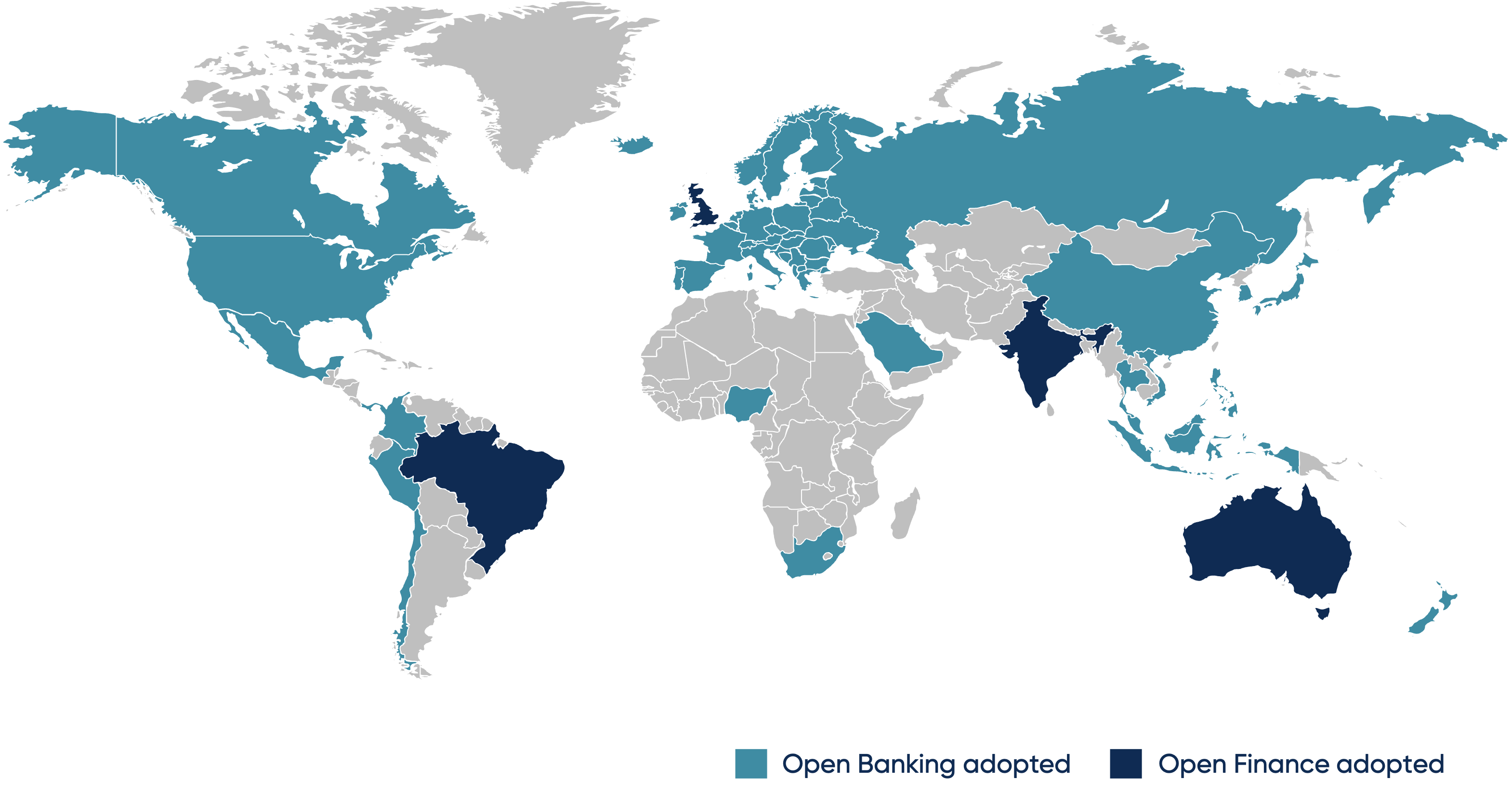

International Experience: What Can Be Derived from Other Markets

A look at international Open Finance pioneers demonstrates that successful ecosystems emerge through different regulatory and strategic pathways. What they share above all is the consistent utilisation of the resulting data spaces.

In the United Kingdom, Open Banking has, for instance, produced a broad ecosystem of banks, FinTechs, and third-party providers. The transition to Open Finance is taking place there progressively. Early standardisation of interfaces and governance structures enables market participants to transfer data-based services step by step into the mass market. Through this approach, the ecosystem has already created economic value of more than four billion pounds. Furthermore, this evolution drives long-term innovation and thereby establishes a foundation for a cross-sector data economy.

In Brazil, the Open Finance ecosystem was driven much more by regulation. Mandatory participation of key players and a clearly structured roll-out led to rapid scaling of data-driven services. The consequence was a measurable shift in market shares in favour of digital providers who systematically integrated Open Finance into existing customer experiences. Thus, three of the five largest banks lost approximately 14 per cent of their market share within eight years following the introduction of the regulation. Concurrently, digital market participants such as Nubank are flourishing and gaining ever-larger market shares. This development demonstrates in an impressive manner how quickly established institutions can come under pressure when data access and customer interface become decoupled.

Europe's Opportunity: FiDA as a Strategic Regulatory Framework

With FiDA, Europe is creating for the first time an independent regulatory framework for Open Finance. The objective is not rapid market opening at any cost, but rather the establishment of a stable, standardised, and consumer-centric data ecosystem.

Against this backdrop, FiDA is not to be understood as regulatory innovation within a national or regional context, but as Europe's response to global structural change. The transition from Open Banking to Open Finance does not mark an incremental step, but rather a new stage of development. For the first time, cross-institutional access to financial data across virtually all product categories is being anchored in regulation. This shifts the focus from individual products towards holistic management of financial information.

In our view, this positions Europe not as a latecomer, but rather as the architect of a sustainable Open Finance ecosystem that combines data-driven innovation with regulatory stability.

From Vision to Implementation:

What Open Finance Concretely Enables

The added value of FiDA consequently does not arise at the level of data sharing, but rather in the capability to utilise this data operationally and strategically. For financial services providers, Open Finance thus becomes a long-term transformational challenge.

The central question is not what data are available, but rather what use cases emerge, what role an institution wishes to assume within the developing ecosystem, and what capabilities must be developed for this purpose. We examine these questions in the forthcoming contributions of our FiDA series, as well as in greater depth in our paper "FiDA in Focus".

Your FiDA Experts

[Translate to English:]

Lukas Meißner

Senior Manager
[Translate to English:]

Jochen Friedrich

Partner

More Impulses on the banking sector

26.01.2026

FiDA Financial Data Access: Strategies & Opportunities for Financial Services | Open Finance Consulting

04.12.2025

BankenTech 2025: AI, Digital Sovereignty & Banking Innovation - Intero Consulting Insights

15.05.2025

Next Generation Financial Service Providers 2025: Resilience as the Key to Success

Hintergrundbild von Hochhäusern
14.02.2025

Banking Trend Cycle 2025

05.12.2024

Handelsblatt BankenTech Trade Fair 2024 - New Trends in the Banking Industry

Roboterhand in einem Netzwerk.
25.04.2024

Next generation financial services provider 2024

Hintergrundbild zu künstlicher Intelligenz
08.03.2024

Generative AI in the financial sector

06.12.2023

Platform economy in banking

Eingefärbtes Hintergrundbild von Hochhäusern
05.07.2023

Banking sector 2022/2023: New trends and changes for banks

16.06.2021

Intero Consulting Banking Trend Monitor 2021

26.01.2026

FiDA Financial Data Access: Strategies & Opportunities for Financial Services | Open Finance Consulting

04.12.2025

BankenTech 2025: AI, Digital Sovereignty & Banking Innovation - Intero Consulting Insights

15.05.2025

Next Generation Financial Service Providers 2025: Resilience as the Key to Success

Hintergrundbild von Hochhäusern
14.02.2025

Banking Trend Cycle 2025

05.12.2024

Handelsblatt BankenTech Trade Fair 2024 - New Trends in the Banking Industry

Roboterhand in einem Netzwerk.
25.04.2024

Next generation financial services provider 2024

Hintergrundbild zu künstlicher Intelligenz
08.03.2024

Generative AI in the financial sector

06.12.2023

Platform economy in banking

Eingefärbtes Hintergrundbild von Hochhäusern
05.07.2023

Banking sector 2022/2023: New trends and changes for banks

16.06.2021

Intero Consulting Banking Trend Monitor 2021

More Impulses on Governance, Risk & Compliance

26.01.2026

FiDA Financial Data Access: Strategies & Opportunities for Financial Services | Open Finance Consulting

Dies ist ein blau eingefärbtes Bild von Architektur.
Protection and Control Made Simple

Effective Risk Management for Low Code/No Code Applications

Dies ist ein blau eingefärbtes Bild von Architektur.
GRC

DORA - Digital Operational Resilience Act

19.03.2025

EU AI Act Compliance 2025: How to Master AI Regulation & Risks

08.11.2024

DORA and management of ICT third-party risks in the financial sector

Hintergrundbild für einen Blogpost zur DORA
11.04.2024

DORA Readiness Analyse

27.09.2023

VAIT-Readiness Assessment

25.01.2023

Governance, Risk & Compliance - Audit Management

26.01.2026

FiDA Financial Data Access: Strategies & Opportunities for Financial Services | Open Finance Consulting

Dies ist ein blau eingefärbtes Bild von Architektur.
Protection and Control Made Simple

Effective Risk Management for Low Code/No Code Applications

Dies ist ein blau eingefärbtes Bild von Architektur.
GRC

DORA - Digital Operational Resilience Act

19.03.2025

EU AI Act Compliance 2025: How to Master AI Regulation & Risks

08.11.2024

DORA and management of ICT third-party risks in the financial sector

Hintergrundbild für einen Blogpost zur DORA
11.04.2024

DORA Readiness Analyse

27.09.2023

VAIT-Readiness Assessment

25.01.2023

Governance, Risk & Compliance - Audit Management

26.01.2026

FiDA Financial Data Access: Strategies & Opportunities for Financial Services | Open Finance Consulting

Dies ist ein blau eingefärbtes Bild von Architektur.
Protection and Control Made Simple

Effective Risk Management for Low Code/No Code Applications

Dies ist ein blau eingefärbtes Bild von Architektur.
GRC

DORA - Digital Operational Resilience Act

19.03.2025

EU AI Act Compliance 2025: How to Master AI Regulation & Risks

08.11.2024

DORA and management of ICT third-party risks in the financial sector

Hintergrundbild für einen Blogpost zur DORA
11.04.2024

DORA Readiness Analyse

27.09.2023

VAIT-Readiness Assessment

25.01.2023

Governance, Risk & Compliance - Audit Management

Our Competence Center GRC