08.09.2026

Banking Trend Report 2026

Trends, Technologies and Regulation at a Glance

Banking continues to face significant pressure to change in 2026. Technological disruption, an increasingly dense regulatory environment, structural competitive pressure from new market entrants and fundamental questions regarding future business models are all presenting institutions with considerable challenges. At the same time, customer expectations of market participants continue to rise.

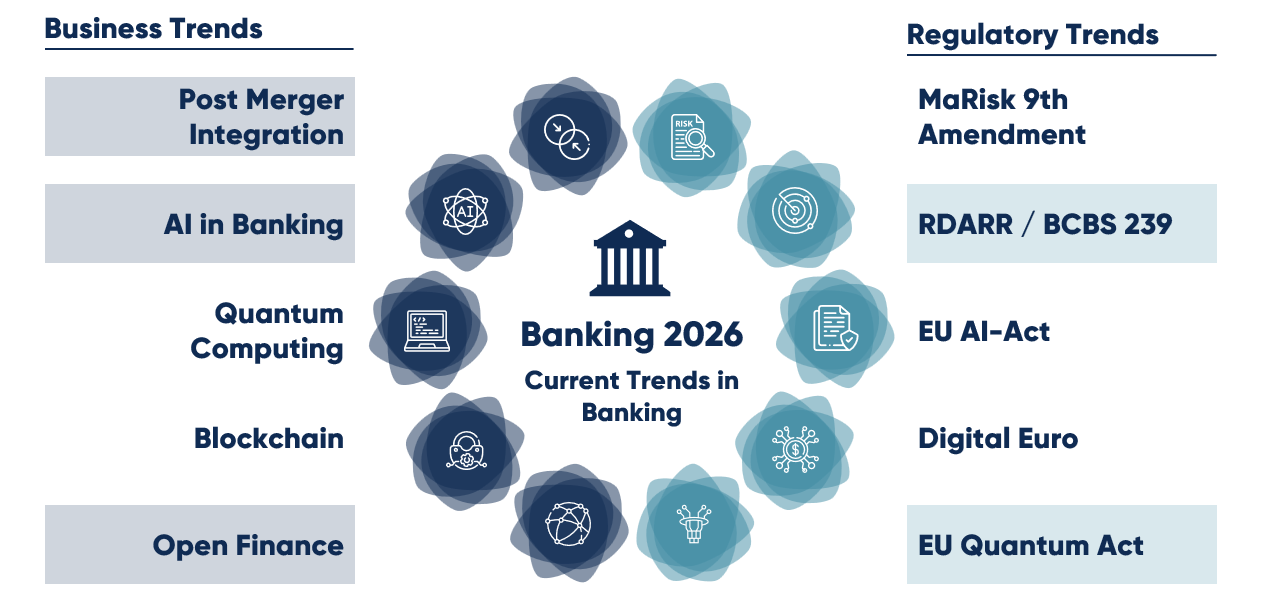
As a management consultancy with many years of experience in the financial services sector, we observe these developments on a continuous basis. As part of our annual offsite, we took a closer look at and analysed, within our Banking Practice, the topics we consider to be most central (see image).

In this article, we would like to offer both substantive and strategic impulses drawn from five selected trend topics.

Business Trends in Focus

Here, we focus on three central trends that influence both the business model and the internal operational processes of institutions. We provide insight into the productive use of AI, the increasing consolidation of the market through mergers and acquisitions, and the gradual opening of financial data as part of Open Finance.


1. AI in Banking

AI systems learn from data, enabling them to recognise patterns within it and make decisions on this basis. Not least for this reason, AI has become strategically indispensable for financial institutions. Furthermore, new entrants to the ecosystem, such as neobanks and other FinTechs, are managing, among other things through the use of AI, to reduce their operating costs to a level that is difficult for traditional institutions to achieve. For institutions wishing to benefit from this development and systematically assess their own AI maturity, our AI Readiness Study offers a pragmatic starting point.
 

A Look at Practice: Fraud Detection

Following AI pilot phases in previous years, AI is becoming increasingly established operationally in 2026. In practice, operating costs in the banking sector can be reduced, for example, through the use of AI to support fraud detection. Traditional systems block transactions according to fixed thresholds, such as any foreign payment above a certain amount. By using AI-supported systems, each transaction can be assigned a dynamic risk score in real time, taking into account up to 200 characteristics. This reduces false positives by 40 to 60 percent, while the detection rate for genuine fraud attempts increases. Fraud detection is well suited as an entry-level AI use case for banks, as the underlying data is already available in every bank. Moreover, it delivers a directly measurable return on investment (ROI). Intero Consulting's AI Readiness approach ensures that, alongside the algorithms, data quality, governance and employees are also incorporated into a shared roadmap at an early stage.


2. Post Merger Integration

Given the ongoing consolidation pressure in the German banking market, the number of bank mergers continues to rise rapidly. Post-merger expertise is thus becoming a decisive success factor in maximising value creation following a transaction. Synergies can be realised through a cleanly executed technical, cultural and organisational integration.
 

A Look at Practice: When a Bank and a Residential Property Fund Manager Merge

Following the acquisition of a residential property fund manager by a bank, IT systems must be merged or taken over, shared services (accounting with SAP, compliance/information security) established, staff transferred, and corporate law matters clarified. Such a transformation cannot take place without intensively bringing the workforce along through comprehensive change management measures.

It is precisely at this interplay that Intero Consulting comes in, supporting banks in interlocking these building blocks so that two separate organisations grow into a single institution that genuinely strengthens its market position, rather than jeopardising it through a bumpy integration.


3. Open Finance

Open Finance extends the current status quo of Open Banking to further financial products such as insurance, pension provision, investments and loans. In doing so, it is a central aim of the EU to shift control over financial data increasingly towards the consumer. With the FiDA Regulation, the EU plans to create a binding framework that allows third-party providers, once the end consumer has given consent, to access that consumer's data via standardised interfaces.
 

A Look at Practice: Open Insurance in the Swedish Market

Sweden already shows what this can look like in practice: SEB (a Swedish bank) has entered into a strategic partnership with the insurtech company Insurely, which aims to set new standards for the insurance industry using open data. The benefit of real-time insurance data for financial institutions is evident on several levels:

  • Sales channels can be managed more efficiently, as customer data can be used across channels to generate more revenue
  • Customer loyalty can be strengthened through personalised offers based on customers' own insurance data
  • Cross-selling and upselling can be designed more effectively, as customer profiles can be addressed more precisely on the basis of an improved data foundation

In addition, SEB gains deeper strategic insights into customer structure, the market, and competitors' products and prices.

It is notable that SEB is already taking action here, even though the corresponding EU regulation on data access (FiDA) has not yet been finally adopted: the trilogue negotiations between the Commission, Parliament and Council have been on hold since the last round in June 2025, and a binding timetable for its entry into force remains undetermined, which is why many institutions are currently taking a wait-and-see approach. It is currently unclear when and in what form FiDA will arrive. However, as the SEB example shows, establishing the necessary conditions within one's own data landscape remains essential regardless.

Regulatory Trends in Focus

Alongside business change, the regulatory framework within which banks operate is also becoming increasingly dense. Both stricter requirements for risk data management and new technology policy initiatives such as the EU Quantum Act are forcing institutions to fundamentally future-proof their data and IT architectures.


4. RDARR / BCBS239

BCBS239 sets out the Basel Principles for effective risk data aggregation and risk reporting, formulated in response to the 2008 financial crisis. The ECB's RDARR Guide of May 2024 makes it unequivocally clear that most institutions still do not fully meet these requirements. With its current supervisory priorities for 2026 to 2028, the ECB has therefore made RDARR one of its central supervisory focus areas, to be pursued rigorously through to 2028. In concrete terms, banks must overhaul their data architectures, make data lineage and quality fully traceable, establish governance processes for risk data, and automate their risk reporting.
 

A Look at Practice: Data Lineage as a Foundation

In practice, banks rarely begin with a complete mapping of all data flows: for organically grown IT landscapes with a large number of different systems, this is simply not feasible. Instead, institutions first prioritise the most supervisory-relevant risk metrics and build a lineage for these through to the source system. In doing so, surprises regularly come to light, such as manual Excel workarounds or undocumented transformation logic that has, in some cases, gone untouched for years. The effort involved is considerable, but only in this way can a data foundation be created that will genuinely withstand an ECB review.


5. EU Quantum Act

The EU Quantum Act aims to position Europe as a leading force in the field of quantum technologies, thereby reducing dependence on other countries. At its core, it is about achieving technological sovereignty in this field by 2030, through the targeted promotion of quantum computing, quantum communication, sensor technology and related applications, as well as a regulatory framework for dual-use aspects. The initiative follows a two-pillar structure: a short-term security policy necessity (post-quantum cryptography) and a long-term innovation opportunity.
 

Outlook: Organisational Implications

This gives rise to two parallel fields of action for companies. In the short term, quantum computing poses a security challenge. Because of "harvest now, decrypt later" (that is, attackers collecting encrypted data today in order to decrypt it once quantum computers have matured), banks must already begin the transition to post-quantum cryptography (encryption methods that can withstand quantum computers, too). Institutions that postpone this transformation risk significant security gaps.

In the long term, however, an innovation opportunity also opens up: building shared resources, such as a European quantum communication infrastructure and competence clusters, lays the foundation for testing quantum algorithms for complex optimisation problems, for example in portfolio risk management, liquidity management or high-dimensional fraud detection.

Overall Conclusion

In conclusion, the banking sector remains in a phase of transformation. Defining central guardrails for issues such as data quality or technological sovereignty is among the key challenges institutions face in order to do justice to these transformative trends. Through holistic development across the dimensions of innovation and regulation, we see an opportunity for banks to build a sustainable competitive advantage. Those who work on individual topics in isolation, however, risk duplicated effort and conflicting objectives between departments.

Your Banking Experts

Dies ist ein Porträtfoto von Sarina Wittchen.

Sarina Wittchen

Partner
Dies ist ein Portrait von Dr. Michael Auer.

Dr. Michael Auer

Partner
[Translate to English:]

Lukas Meißner

Senior Manager

More Impulses on the banking sector

08.09.2026

Banking Trend Report 2026

01.07.2026

Data Strategy & FiDA: Ready for Open Finance

20.04.2026

AI Projects in Banking: A Reality Check

17.04.2026

Open Finance in Practice: 2 Use Cases of the FiDA Regulation

Focus Topic

FiDA Financial Data Access: Strategies & Opportunities for Financial Services | Open Finance Consulting

04.12.2025

BankenTech 2025: AI, Digital Sovereignty & Banking Innovation - Intero Consulting Insights

15.05.2025

Next Generation Financial Service Providers 2025: Resilience as the Key to Success

Hintergrundbild von Hochhäusern
14.02.2025

Banking Trend Cycle 2025

05.12.2024

Handelsblatt BankenTech Trade Fair 2024 - New Trends in the Banking Industry

Roboterhand in einem Netzwerk.
25.04.2024

Next generation financial services provider 2024

Hintergrundbild zu künstlicher Intelligenz
08.03.2024

Generative AI in the financial sector

06.12.2023

Platform economy in banking

Eingefärbtes Hintergrundbild von Hochhäusern
05.07.2023

Banking sector 2022/2023: New trends and changes for banks

16.06.2021

Intero Consulting Banking Trend Monitor 2021