04.11.2026

Post-Quantum Cryptography for Banks DORA, NIS2, BSI

Post-Quantum Cryptography Is Becoming Regulatory Reality How Is European Regulation Already Making Quantum Risk a Relevant Issue for Banks?

Quantum computing has been on the horizon for years. As the technology matures, however, that horizon is drawing ever closer, and it is becoming increasingly difficult to treat quantum computing as a distant technology topic.

Quantum computing is appearing more and more in technology strategies, cybersecurity discussions and the European regulatory landscape. This raises a practical question for banks: when does post-quantum cryptography move from being a topic to be monitored to one that requires action?

We work with many players from the banking and insurance sector. Given our expertise in regulatory requirements such as DORA and NIS2, we have therefore examined post-quantum cryptography from both a regulatory and a technical perspective.

Our conclusion: the regulatory clock is ticking and technological pressure is rising.

The Risk Begins Before Quantum Computers Are Available

A large part of today's digital infrastructure is based on public-key cryptography. In simple terms, public-key cryptography uses a pair of mathematically linked keys, one public and one private, to exchange information securely and verify identities without first having to exchange a secret key. It protects confidential communication, authenticates systems and users, enables digital signatures and forms the foundation of trust for networked systems.

The problem is that sufficiently powerful quantum computers will one day break important public-key cryptographic algorithms that are in use today. The European Commission therefore describes the transition to post-quantum cryptography, or PQC for short, as necessary to protect Europe's digital infrastructure against future quantum attacks.

It would be easy to conclude that this only becomes a problem once such a quantum computer exists. However, that overlooks a significant danger.

Information that is encrypted today can be, and already is being, collected and stored with the aim of decrypting it as soon as the necessary quantum technologies become available. The European Commission explicitly warns that data which must remain confidential in the long term may already be at risk today, and points out that so-called "harvest now, decrypt later" attacks are probably already taking place.

For banks, this changes the question. Instead of asking "When will quantum computers be powerful enough?", banks should increasingly ask:

"Which of our data must remain confidential in the future?", "Which systems protect this data?" and "Where should we already be preparing the transition to quantum-safe methods today?"

To make matters worse, cryptography cannot simply be replaced overnight. It is embedded in applications, infrastructure, certificates, interfaces and third-party services. Preparing for PQC is therefore as much a migration challenge as a cryptographic one.

There Is No Single "PQC Regulation", but the Framework Is Taking Shape

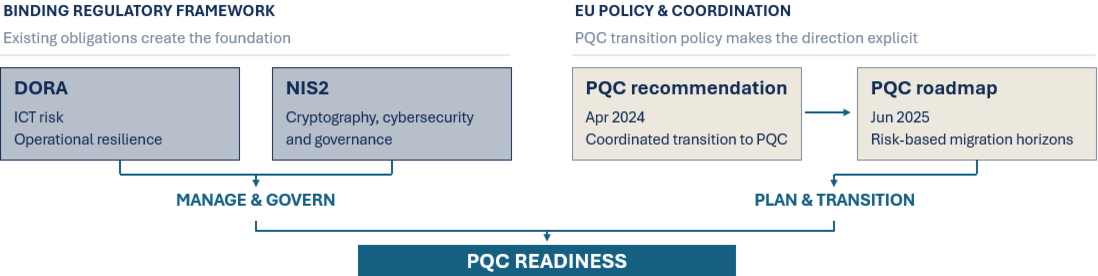
Looking at PQC from a regulatory perspective, one thing becomes clear: there is no single European regulation that tells banks precisely which post-quantum algorithm they must implement and when.

Instead, several regulatory and policy instruments are increasingly interlocking.

For banks, DORA provides the sector-specific framework for ICT risk. NIS2 creates the broader European context for cybersecurity and governance; where DORA regulates corresponding requirements on a sector-specific basis, these DORA requirements apply to the financial entities concerned in place of the corresponding NIS2 provisions.

The EU's PQC Recommendation and the joint guideline from BMDS, BMI and BSI on the national implementation of the EU roadmap, published on 12 October 2026, make the direction of the transition more concrete. Recommendations and guidelines must be distinguished from directly applicable legal obligations.

DORA
NIS2
BSI Guideline
Why Quantum Risk Is Already Relevant for Financial Institutions

DORA has applied since January 2025 and firmly anchors ICT risk management and operational resilience in the regulatory responsibility of financial entities. Existing requirements already expect financial institutions to manage their ICT risks and maintain appropriate cryptographic controls.

PQC is therefore more than a research topic for the security architecture team. It is increasingly linked to the overarching questions that DORA has already brought into focus: What ICT risks do we have? Which controls protect critical systems? What dependencies exist on technology providers? And can we demonstrate that these risks are being actively managed?

The following milestones for organisations on the path to Quantum-Readiness can be derived in particular from the BSI roadmap:

  • By the end of 2026

    The preparation phase is complete: responsibilities are assigned, a first cryptographic inventory is drawn up, and a risk-based plan with deadlines is in place.

  • By the end of 2030

    Use cases with a high quantum risk should be migrated to quantum-safe cryptography by the end of 2030.

  • By the end of 2035

    The transition should be completed for use cases with medium risk and carried out as far as practicable for use cases with low risk.

Whether these tight timelines are truly necessary depends on the pace at which the technology is developing. Quantum computing is a double-edged sword which, alongside the risks, also holds considerable potential. As a result, a wide range of companies and institutions are driving technological development. We saw the emergence of an economic ecosystem around quantum computing, for example, at Bitkom's AI, Data and Quantum (AIDAQ) conference in Berlin. Technological development is expected to accelerate further in the coming years, driven by AI and by funding such as that announced in the EU Quantum Act. Rapid technological development, however, also means growing technological risk and increasing pressure to act.

Beyond Regulation: Post-Quantum Decryption Is a Technology Risk

Post-quantum cryptography (PQC) is necessary regardless of regulation: the technological risk exists today. Attackers can steal and store sensitive data now in order to decrypt it later using powerful quantum computers.

One possible scenario illustrates the risk: if customer, payment or transaction data is stolen today and decrypted in 2031, for example, the disclosure of confidential information cannot be prevented retrospectively. Attacks on digital identities and signatures are a separate matter: these may become possible if the cryptographic methods used for them are broken by powerful quantum computers. Both attack paths, data decryption and signature forgery, can shake trust in digital processes.

Possible worst-case scenario for a bank: attackers decrypt intercepted account balances and payment histories, exposing the bank to liability claims and customer attrition as a result of the loss of trust. At the same time, the attackers break quantum-vulnerable certificate and signature methods: using forged identities, they initiate fraudulent transfers. The bank suffers financial losses and has to block access and interrupt payment processes. High recovery costs and lasting reputational damage aggravate the consequences.

Migration is therefore not a pure compliance task, but a technical and economic necessity.

What Should Banks Do Now?

To avoid such nightmare scenarios, it is important that banks take action today in order to be prepared. This does not mean replacing every encryption method immediately. The first step is to build an overview of potential vulnerabilities and the measures required.

The aim of the preparation phase is to understand the existing cryptographic landscape, identify the most significant threats and build the capability to migrate in a controlled manner. The starting point is, somewhat surprisingly, something familiar: a cryptographic inventory.

Quantum-Readiness: Where Do You Start?

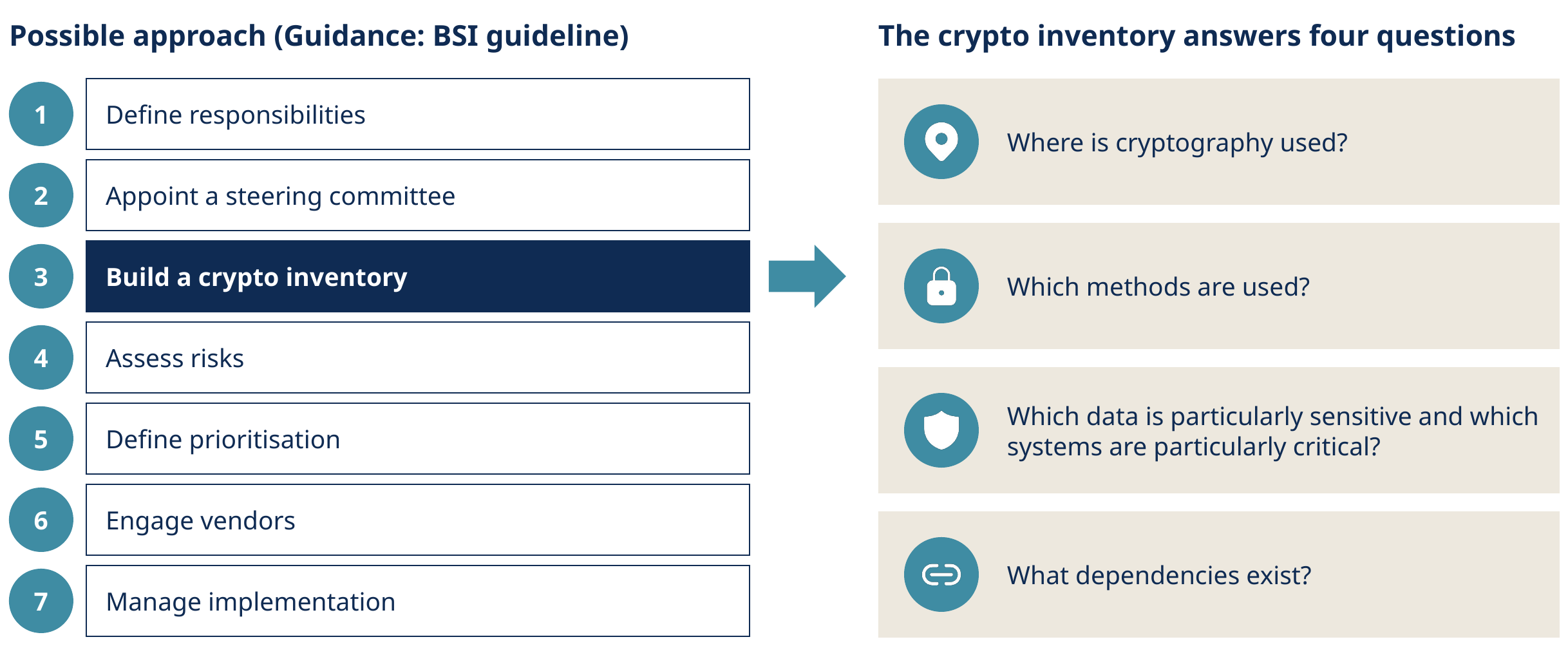
Such an inventory is not created by a technical stocktake alone: it must first be clear who is responsible for the collection and who coordinates the further measures. The BSI guideline offers orientation here; from it, a possible approach for banks to prepare for PQC can be derived. The cryptographic inventory forms the basis for a targeted transition to quantum-safe methods.

Cryptographic Inventory: What Needs to Be Recorded?

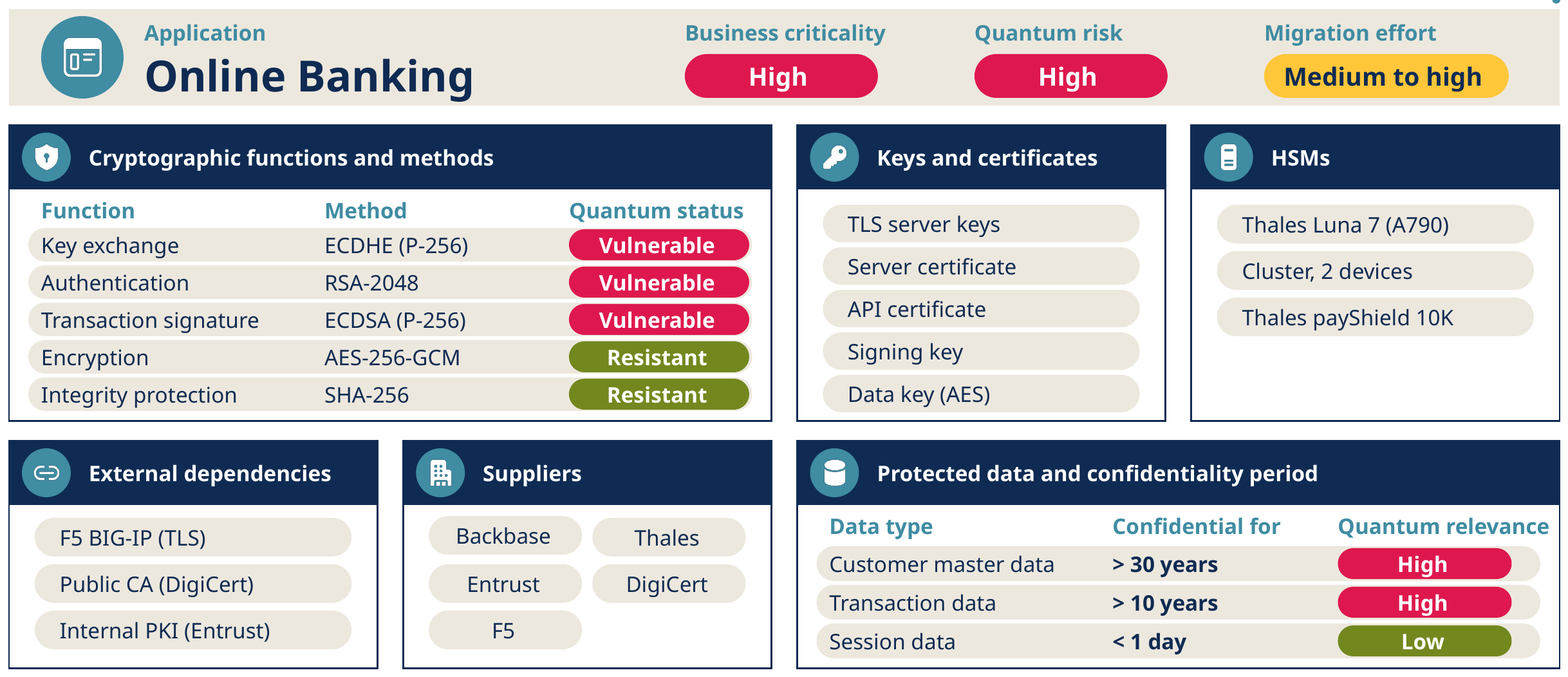
A record with various pieces of information should be created for each component in the IT landscape:

  1. Which cryptographic functions are used?
  2. Which cryptographic methods are used?
  3. Which HSMs are used?
  4. What external dependencies exist?
  5. Which suppliers are involved?
  6. How high is the quantum risk?
  7. Which data is processed, and for how long must it remain confidential?
  8. How high is the migration effort?

An entry in the cryptographic inventory could look like this, for example:

Cryptographic Inventory: How Do You Collect the Data?

The more complete the cryptographic inventory, the lower the risk that potential vulnerabilities will be overlooked during the transition. All IT components should therefore be taken into account.

Under DORA, a bank remains responsible for meeting its regulatory obligations even when using external ICT services. Components and services obtained from third-party providers should therefore also be included in the cryptographic stocktake.

Creating the cryptographic inventory can be broken down into 4 steps:

  • Step 1: Overview of the Cryptographic Landscape (Crypto Discovery Assessment)

    To ensure that the inventory is complete, all components should first be recorded, for example in the form of a checklist. Suitable means can include workshops, architecture analysis and supplier analysis.

  • Step 2: Automated Stocktake (Discovery)

    Specialised tools can be considered for the automated stocktake. The choice depends on the IT landscape, the scope of coverage required and the interfaces. The following products are examples, not a blanket recommendation:

    • Keyfactor
    • Venafi
    • IBM Guardium Quantum Safe
    • SandboxAQ
  • Step 3: Assessment of Quantum Risks (Quantum Risk Assessment)

    To prioritise the individual implementation steps, components should be assessed in terms of their threat level and migration effort.

    Assessment by:

    • Vulnerability
    • Damage potential
    • Migration effort
  • Step 4: PQC Migration Planning (PQC Migration Roadmap)

    with risk-based prioritisation and orientation towards the milestones of 2030 and 2035 recommended by the BSI.

Checklist for the Cryptographic Inventory:

Infrastructure
Identities
Applications
Third-party providers
Data stocks

☐ TLS certificates

☐ VPN gateways

☐ Firewalls

☐ Load balancers

☐ HSMs (hardware security modules)

☐ DNSSEC

☐ WLAN infrastructure

☐ Email encryption

Quantum-Readiness: What Comes After the Cryptographic Inventory?

PQC preparation first means understanding the cryptographic landscape, assessing risks and being able to plan and steer the migration. The longer-term target picture goes further, covering implementation and permanent embedding in processes. This includes the following:

  • all critical cryptographic methods are inventoried
  • systems have been classified by quantum risk
  • high-risk systems have been migrated to PQC or hybrid methods
  • procurement and architecture will in future permit only PQC-capable solutions
  • suppliers demonstrably have PQC roadmaps
  • PQC is a firm component of architecture, risk and security processes
Drei Consultants beraten sich zwischen ihren Arbeitsplätzen.

The Conversation Has Only Just Begun

When powerful quantum computers will be able to break today's cryptographic methods remains uncertain. We are, however, already looking forward to entering into dialogue about both the opportunities and the risks of quantum computing.

Measures to protect against risks such as "harvest now, decrypt later" threats should be taken today. The first step is to create transparency about your own cryptographic landscape, as the basis for robust decisions rather than hasty changes.

If PQC is already on your agenda or you are looking for a sensible starting point, we would be glad to talk with you. We support you in creating your cryptographic inventory and help you align the next steps with your systems, risks and dependencies.

Your Digitalisation Experts

Dies ist ein Porträtfoto von Sarina Wittchen.

Sarina Wittchen

Partner
Dies ist ein Portrait von Dr. Michael Auer.

Dr. Michael Auer

Partner
[Translate to English:]

Christin Mädler

Senior Consultant

Further Impulses on Digitalisation

04.11.2026

Post-Quantum-Cryptography: What Banks Need To Know Now

01.09.2026

Ensuring Data Protection and Data Security

01.07.2026

Data Strategy & FiDA: Ready for Open Finance

May 12th 2026

AIOps as an Enabler for IT Operations in the Financial Sector

20.04.2026

AI Projects in Banking: A Reality Check

Focus Topic

AI Readiness as Competitive Advantage: A Strategy Guide

11.12.2025

Optimize Data Quality: Enterprise Data Management Framework for Digital Excellence

Dies ist ein Titelbild mit einem Gehirn, das von Noden umgeben ist und auf ChatGPT als KI-Model verweist.
26.06.2025

Successfully Implementing AI: The Human Factor as the Decisive Success Factor

21.03.2025

Efficiently Managing Cloud Costs: How FinOps Revolutionises Your Financial Management

14.03.2025

Digital Transformation in the Real Estate Industry: How Top Companies Are Future-Proofing Their Investments

Hintergrundbild Impuls KI-Integration bei Intero Consulting
31.01.2025

Implementing an AI Assistant at Intero Consulting

06.12.2024

Digitalization in asset management - AI, Automation and Tokenization

26.09.2024

AI in insurance

Digitization

Artificial intelligence Potential analysis

Headerbild mit einem digitalen Dashboard mit Grafiken und Diagrammen.
15.07.2024

TCO Dashboard

Hintergrundbild zu künstlicher Intelligenz
08.03.2024

Generative AI in the financial sector

06.12.2023

Platform economy in banking

04.12.2023

Best of Consulting Mittelstand Award 2023

17.08.2023

Cloud Native Conference 2023

Eingefärbtes Hintergrundbild von Hochhäusern
05.07.2023

Banking sector 2022/2023: New trends and changes for banks

09.02.2022

EXPO 2020 Dubai - The world shares its ideas

17.01.2022

WEB SUMMIT 2021

12.10.2021

Whitepaper Cloud journey: Roadmap to the cloud

05.10.2021

Cloud Computing Whitepaper

29.09.2021

Whitepaper Cloud Implementation and Migration

Our Competence Center Digitalisation