GRC

NIS-2 Directive 2025: EU Compliance Consultancy

Simple. Swift. Compliant Achieve NIS-2 compliance in 30 minutes – without lengthy consultancy projects

90% of our clients receive immediately actionable NIS-2 solutions


What is NIS-2? The Essential Facts (2025)


The NIS-2 Directive affects approximately 29,000 UK companies across 18 sectors since October 2024. Companies with 50+ employees or €10+ million turnover must register with national authorities and meet cybersecurity minimum standards.

Quick Check: Energy, transport, banking, healthcare, manufacturing, telecommunications affected?
External content - Typeform survey

Here you will find content from a third-party provider that you can display with one click

This may result in personal data being transmitted to the third-party provider. You can find more information in our privacy policy

Current Legal Position: What EU Companies Need to Know in 2025

 Post-Brexit Development: Whilst the UK is no longer bound by EU directives, UK companies operating in the EU must still comply with NIS-2 requirements for their European operations.


Latest insights from regulatory workshops:


  • Proportionality principle: No new tools required – simple concepts suffice
  • Availability: Normal business hours availability sufficient (no 24/7 service needed)
  • Pragmatic approach: Measured response rather than over-engineering


Special provision for financial services:


DORA-subject companies need only register with relevant authorities – reporting obligations remain with existing regulators (no duplicate structures).


Critical Infrastructure vs. NIS-2 – the crucial difference:


  • Critical Infrastructure: Asset-based (specific infrastructure)
  • NIS-2: Entity-based (entire organisation)


Good news for certified organisations:


ISO27001 certification covers ~95% of risk management obligations – only reporting requirements and registration additional.


International operations:


Registration required in all EU countries with business activities – even without physical EU presence.

These 3 questions are asked by 9 out of 10 companies:

“Are we affected by NIS-2?”
→ Answer in 10 minutes with compliant assessment tool

“What must we implement by when?”
→ Prioritised roadmap with concrete deadlines

“Will this be expensive and lengthy?”
→ 95% already meet basic requirements – only documentation missing


Most Common NIS-2 Misconceptions (and Reality)


"We need completely new IT infrastructure"
A structured security concept often suffices

"This costs millions and takes years"
90% of our clients are compliant within 2-6 weeks

"We need 24/7 standby services"
Availability during business hours suffices

"Our ISO27001 certification doesn't help"
Covers 95% of risk management requirements

External content - Typeform survey

Here you will find content from a third-party provider that you can display with one click

This may result in personal data being transmitted to the third-party provider. You can find more information in our privacy policy

Particularly Relevant: Your Industry

  • Financial Services (DORA-subject)
    • Only authority registration required
    • Reporting obligations remain with existing regulators – no duplicate structures
    • DORA compliance covers 95%
  • Critical Infrastructure
    • Minimal changes for existing critical infrastructure operators
    • Existing regulatory processes can be maintained
    • Only additional documentation required
  • ISO27001 Certified Organisations
    • 95% of requirements already met
    • Only reporting procedures and registration additional
    • Gap assessment possible in under 2 weeks

What you receive in our free 30-min consultation:

Instant Clarity
Practical Roadmap
Immediate Protection
(10 min)
  • Definitive applicability assessment
  • Critical compliance gaps identified
  • Realistic penalty risk evaluation

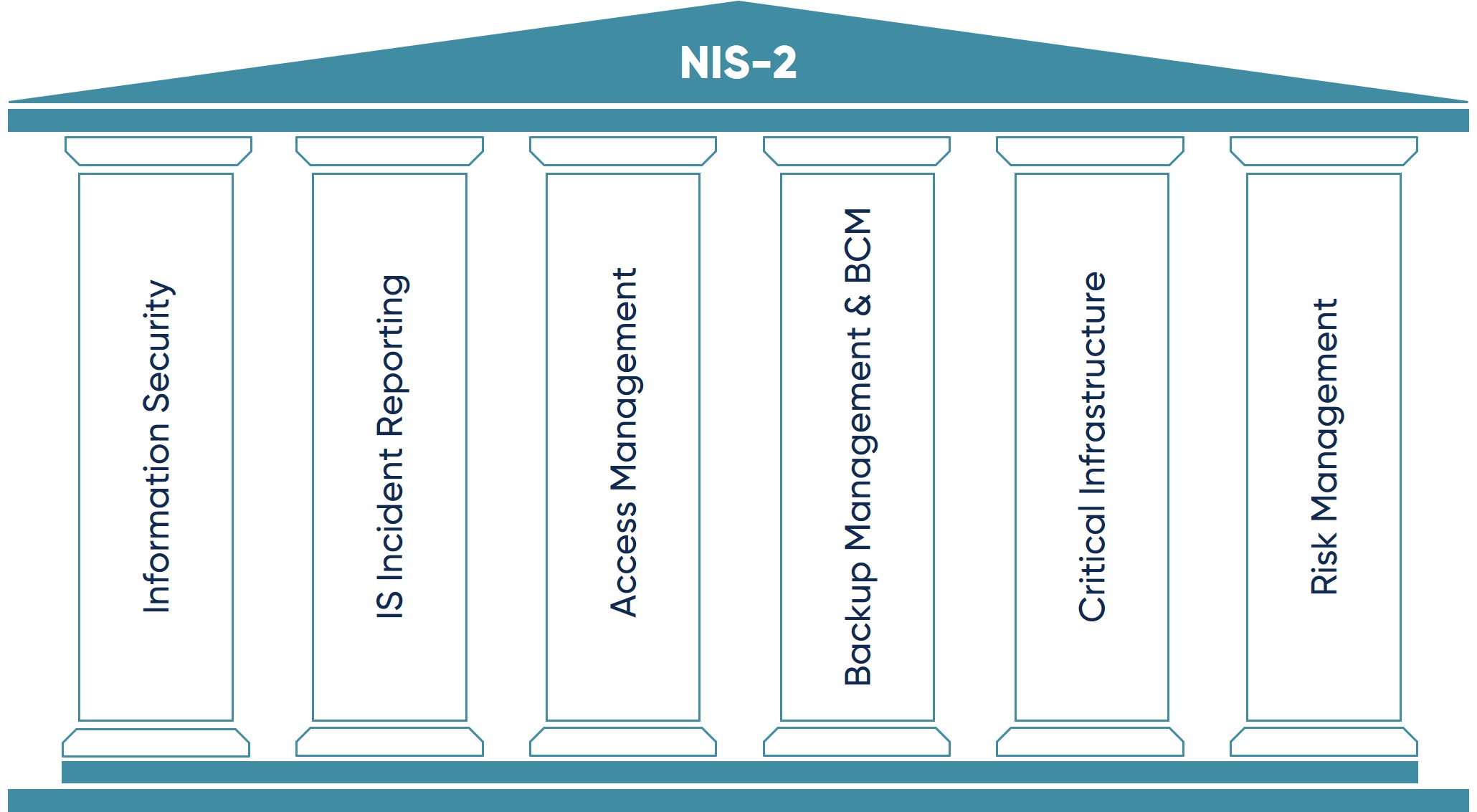
Focus Topics of the NIS2 Directive

Fokusthemen der NIS2-Richtlinie als Schaubild dargestellt.
  • Information Security

    The NIS 2 directive establishes minimum requirements for security measures that must be implemented to strengthen a company's essential information security objectives. The focus here is on confidentiality, integrity, and availability, especially regarding all types of information, documents, software, and hardware. It is fundamentally important to maintain the four dimensions of information security (according to ISO 27001) through physical security, IT security, organizational security and personnel security.

  • IS Incidenct Reporting

    The regulations in the area of incident reporting require essential and important companies to promptly report substantial IT security incidents (including outsourced services) to the relevant national authorities and to register the affected facilities and components. A two-stage reporting process must be followed, during which a preliminary report must be submitted within 24 hours. In the second stage, detailed information about the incident, including its impact and the immediate measures taken to mitigate it, must be provided within 72 hours. Enhanced reporting obligations can arise from the classification of incidents and the associated potential for significant impact. Sanctions may be imposed for late or omitted reporting. Therefore, companies must ensure that their communication channels for incident reporting are robust and fast enough to meet the requirements of the NIS-2 directive.

  • Access Management

    To ensure that only authorized users can access critical information and systems, the NIS 2 directive requires the implementation of effective access controls. These include not only access permissions for buildings and rooms but also the introduction of role-based access controls (RBAC) to govern access to information according to the respective permissions. Furthermore, the regulation demands comprehensive documentation of granted access rights, including any changes made. It is essential to raise employees' awareness of cybersecurity risks through training.

  • Backup Management & BCM

    In addition to responding to IT security incidents, the NIS-2 directive, as part of backup and business continuity management, also aims to implement measures that should increase resilience against potential cyberattacks proactively. The focus is on the uninterrupted availability of a service. Specifically, the development and implementation of emergency plans are required, which must undergo regular testing and reviews. Furthermore, provider exit strategies must be demonstrated in connection with this. All backup and recovery procedures need to be documented.

  • Critical Infrastructure

    The NIS-2 directive particularly serves to protect critical infrastructures (KRITIS) from disruptions and cyberattacks. Since October 2024, it represents an extension of the German KRITIS regulation. There are just few changes for existing critical infrastructures, but approximately 29,000 "especially important" companies are additionally included by NIS-2. More specifically, these are companies whose failure would impair public safety or the common good and that can be assigned to one of the sectors listed in Annex 1 (NIS-2). These companies are subject to stricter regulations (BCM, resilience measures, IAM, physical protection) and regular reporting obligations. Furthermore, the institutions are required to conduct a due diligence analysis to assess the risks in supply chains and procurement that have a direct impact on critical areas. To ensure continuous service delivery, alternative supply chains should also be identified.

  • Risk Management

    Companies must implement a systematic risk management process in accordance with international standards (ISO 31000, ISO 27005, BSI Standard 200-3), which includes regular risk analysis. This pertains to both internal and external risks and encompasses the identification, assessment, and treatment of risks related to information systems. A systematic cross-cutting approach should be pursued to ensure a structured and continuous improvement of security measures. It is essential to adhere to the state of the art. Backup solutions, encryption methods, Multi-Factor Authentication (MFA), and Identity & Access Management (IAM) should be integrated into the risk management process.

FAQ: The Most Important NIS-2 Questions

“Which organisations are affected?”
18 sectors (energy, transport, manufacturing, financial market, healthcare, drinking water, etc.) with medium and large organisations (50+ employees or €10+ million turnover)


“What happens in case of violations?”
Penalties up to €10 million or 2% of global annual turnover – personal liability of management possible


“Is our ISO27001 certificate sufficient?”
Covers 95% of risk management requirements, but reporting obligations and registration remain


“Must we purchase new software?”
No – in 95% of cases, existing systems with improved documentation suffice


“How does NIS-2 differ from critical infrastructure regulation?”
Critical infrastructure is asset-based, NIS-2 is entity-based and covers the entire organisation

In a 30-minute consultation you receive:


  • Definitive clarity about your applicability
  • Prioritised 3-5 point roadmap
  • Immediately actionable templates and checklists
  • Realistic cost and time estimation
  • Concrete next steps with deadlines


If after the consultation you don't have at least 3 concrete, immediately actionable measures, we'll compensate you for your time.

Your experts for NIS-2

[Translate to English:]

Jochen Friedrich

Partner
[Translate to English:]

Tobias Dusch

Associate Manager

Our Competence Center GRC